Blog
Hospitality Furniture Suppliers

Hospitality Furniture Suppliers: The Complete Guide to Sourcing Solid Teak Furniture from an Indonesia Furniture Manufacture Exporter
Sourcing furniture for a hotel, restaurant, café, or resort is different from furnishing a home. Hospitality furniture must survive daily commercial use. It has to meet delivery timelines tied to a project opening date. It also has to arrive in matched quantities across an entire property, and still look like a design decision rather than a compromise. For architects, contractors, interior designers, and hospitality operators, choosing the right hospitality furniture suppliers is one of the highest-leverage decisions in a project. It’s also one of the easiest decisions to get wrong.
This guide covers what actually matters when you source hospitality furniture internationally. It explains why solid teak remains one of the strongest material choices for commercial interiors. It also shows what separates a genuine indonesia furniture manufacture exporter from a reseller working off borrowed stock.
Why Hospitality Furniture Sourcing Is Different
People choose residential furniture once and use it lightly. Hospitality furniture faces constant use: multiple seatings a day, years of cleaning cycles, spills, sun, humidity, and the wear of hundreds of different guests. A chair can look identical to a residential model on a spec sheet, yet it can fail within a year in a restaurant if the maker didn’t engineer it for that load.
This is why hospitality furniture suppliers need different evaluation criteria than a home furniture retailer:
- Durability under commercial use, not just visual appeal
- Consistency across large order quantities, since a hotel or restaurant needs dozens or hundreds of matching pieces, not one showpiece
- Export logistics capability, since most hospitality projects source internationally to get the right material, price, and design at scale
- Material legality and sustainability documentation, which hotel groups, developers, and import regulations increasingly require
- Design flexibility, since hospitality brands want furniture that reinforces their identity, not generic catalog stock
Why Solid Teak Wood Is a Leading Material for Hospitality Interiors
Among the materials hospitality furniture suppliers offer, solid teak wood (Tectona grandis) stands out for commercial applications. Here’s why it works so well.
Natural durability. Teak contains high natural oil content. This makes it naturally resistant to moisture, insects, and decay. These properties matter enormously in food and beverage environments, where staff clean furniture daily and it’s exposed to spills.
Dimensional stability. Properly kiln-dried teak resists warping and cracking, even when it moves between climates. This matters for furniture manufactured in Southeast Asia and shipped to Europe, the Americas, or the Middle East, where humidity and temperature conditions can differ sharply from the country of origin.
Aging character. Solid teak develops a richer patina over years of use instead of looking worn out. Painted or laminated furniture can’t match that. Hospitality brands increasingly value this quality as part of a warm, natural design language.
Structural strength for commercial joinery. Teak’s density supports mortise-and-tenon and dowel joinery that holds up to constant use, repeated stacking, and transport. Engineered wood and softer timbers struggle to match this over a multi-year commercial lifecycle.
Material Legality: Why Certification Matters as Much as Craftsmanship
A genuine hospitality furniture supplier doesn’t just claim to use solid teak. They document where the wood came from and confirm they harvested and processed it legally. Indonesia governs this through SVLK (Sistem Verifikasi Legalitas Kayu), the country’s mandatory timber legality verification system. Legal teak export requires this certification.
This matters for two practical reasons. First, many international buyers — particularly hotel groups, developers, and government-linked hospitality projects in Europe and the Middle East — now require documented proof of legal timber sourcing as part of procurement compliance. Second, it protects the buyer from legal and reputational exposure. Importing illegally sourced wood remains an ongoing concern in the global furniture trade.
When you evaluate an indonesia furniture manufacture exporter, ask directly whether they can provide SVLK documentation or equivalent legal certification for the specific timber batch in your order. A general claim that “our wood is legal” isn’t enough.
What a Genuine Manufacturer-Exporter Offers That a Trading Company Cannot
One of the most consequential sourcing decisions is whether you work with an actual manufacturer or a trading company that resells stock from multiple factories.
In-house design and production control. A manufacturer can modify leg profiles, finishes, dimensions, and joinery details to match a specific interior concept. A trading company can only offer whatever stock its supplier network happens to have.
Consistency across a full order. Hospitality projects need matching quality across dozens or hundreds of units. A manufacturer that produces everything in one workshop can maintain consistent grain selection, finish tone, and construction quality. A trading company that sources from multiple factories often can’t guarantee that same consistency batch to batch.
Realistic lead times and MOQ flexibility. A manufacturer controls its own production schedule. This lets it give more accurate lead times and adjust minimum order quantities for a genuine project. A reseller depends on someone else’s factory capacity and often can’t do this.
Direct accountability for quality and export packing. When something goes wrong — a finish issue, a shipping delay, a packing failure — a manufacturer-exporter takes direct accountability and has the production knowledge to fix it. A trading company often just relays the problem to a factory it doesn’t control.
Designing for Photogenic, Brand-Defining Hospitality Spaces
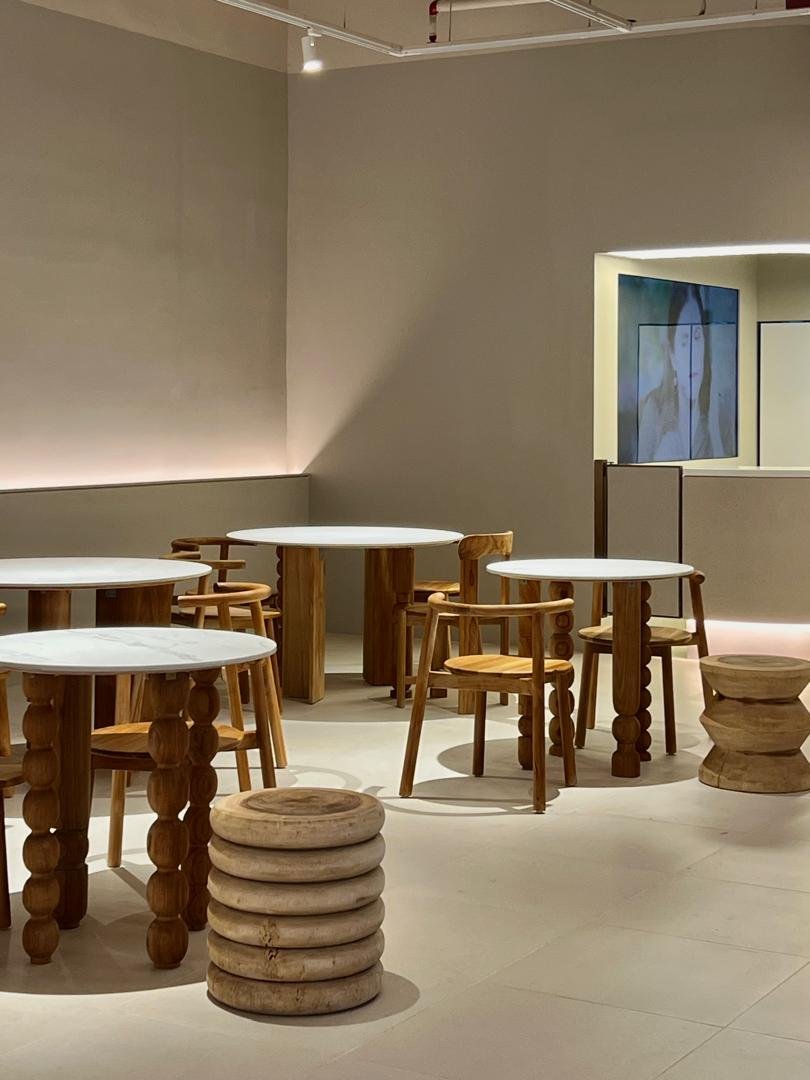
Hospitality interiors today serve brand identity and organic social media exposure as much as seating capacity. Furniture with a distinctive silhouette — a signature table leg design, a sculptural stool, a curved chair form — gives a space a recognizable visual identity. Guests photograph and share that identity, and it has become a real driver of hospitality marketing.
This is where working with a manufacturer pays off directly. A supplier with in-house design and production capability can develop or adapt a signature piece specifically for your project, instead of only offering what’s already in a catalog. Solid teak suits this kind of design work particularly well. Makers can turn it, steam-bend it, and hand-finish it into forms that engineered materials can’t replicate with the same warmth or durability.
What to Ask Before Choosing a Hospitality Furniture Supplier
Before you commit to a supplier for a hospitality project, confirm the following directly:
- Do they manufacture in-house, or resell from third-party factories?
- Can they provide legal timber certification (such as SVLK) for the specific wood in your order?
- What is their process for kiln-drying and moisture control for your destination climate?
- Can they show examples of past hospitality projects at the scale you need?
- Do they have genuine export experience — documentation, container logistics, and packing built specifically for solid wood furniture shipped internationally?
- Can they maintain consistent quality across a full production run, not just a single sample?
A supplier who can answer all of these clearly, with documentation to back it up, is a fundamentally safer long-term partner than one who only offers a catalog and a price list.
Sourcing Hospitality Furniture from Indonesia
Indonesia — and Jepara, Central Java in particular — has been a center of teak furniture craftsmanship for generations. The region combines traditional joinery skill with modern export infrastructure. For hospitality projects across Europe, the Americas, and the Middle East, sourcing directly from an established indonesia furniture manufacture exporter offers a combination that’s hard to match elsewhere: genuine solid teak at commercial-grade quality, legally certified timber, custom design capability, and full container export experience built specifically for international hospitality contracts.
Final Thoughts
Choosing hospitality furniture suppliers isn’t just a procurement task. It’s a decision that affects how a space performs, how it photographs, how long it lasts, and how much risk a project carries around legality and consistency. Solid teak wood, sourced from a legally certified, genuine manufacturer-exporter, gives architects, contractors, and hospitality operators a material and a partner built for the realities of commercial use rather than residential expectations.
If you’re planning a hospitality project and evaluating suppliers, start by asking the questions above before you finalize a design. The answers will tell you more about long-term reliability than any product photo can.
Case in point:
We recently supplied solid teak furniture for Super Kimchi, a café and restaurant concept in Johor Bahru, Malaysia — including a coordinated set of bead-turned leg dining tables, matching teak chairs, and stacked-ring stools designed to give the space a distinctive, photogenic identity.